

Sub-Total: $0.00
Categories
- Accessories
- Animals
- Animated Lighting
- C7 and C9 Bulk Lighting
- Celebrate 250
- Clearance Items
- Custom Designs
- Dimensional Sculptures
- Easter
- Electrical Products
- Garland and Wreaths
- Halloween
- LED Lights
- LED Rope Light
- Lights
- Manufactured Christmas Decorations
- Miscellaneous Outdoor Christmas
- New 2026
- New Arrivals
- Novelty Lights SALE!
- Patriotic Items
- Prelit Trees
- Religious
- Repairs and Refurbishment
- RV and Camping Lights
- Saint Patrick's Day
- Santa and Elves
- Signs
- Thanksgiving
- Top Sellers
- Transportation
- Trees
- Tropical
- Valentines Day
- Winter/Snowy
LED Half Wave vs. Full Wave
Full Wave Rectified vs. Half Wave Rectified
Rectifiers control the amount and type of power flowing to your LED bulbs. Full-wave (fully rectified) sets deliver steady, flicker-free light, while half-wave sets cost less but come with a slight flicker. Here's how the two compare.
Half Wave Rectified
Half wave rectified or (half wave) LED string light sets flicker or turn on and off at the rate of 60 times per second (AC-Alternating Current). Although this is very fast, it is still detectable by the human eye. Thus, most people can detect a faint flickering in non-rectified sets of LED string lights. The flickering or strobing effect is especially pronounced when the lights or the person viewing the lights are in motion. This is the most common complaint from consumers about LED Christmas lights. Non-rectified light sets are generally of lower quality than the rectified sets and can be found in most box stores.
Full-Wave
Full-wave sets are a superior style of light sets. The LEDs get more consistent and constant power than they would in a half-wave set. This means they don’t flicker as much and can better handle use on light controllers, such as faders. Typically, full-wave sets are brighter as well.
Fully rectified, or (full wave) LED string light sets produce a steady flow of light without the flicker or strobing effect. In contrast, rectified or “full wave” LED lights use a device known as a rectifier, which essentially converts alternating current to DC (direct current). The result of the rectification is an LED Christmas light that is substantially brighter and has no visible “flicker.”
Our LED Christmas lights use fully rectified technology to ensure steady shine and true color. Rectified sets allow you to connect to any control box to fade in or out and/or set your choice of random twinkling. Fully rectified sets are generally used for commercial applications and can be found through commercial wholesale Christmas suppliers or high-end garden centers.
Why Non-Replaceable Bulbs
LEDs are polarity-specific. If a bulb is removed and then turned around and reinserted, it will not work. If several bulbs have fallen out of the socket over time, then it is almost impossible to determine which one is inserted backwards. In these cases, often the entire set will not light.
Rust issues make the best case for a non-replaceable LED because the leads of the LED and the copper wire of the cord are different materials, making them susceptible to rust. If any moisture is introduced into the environment of the bulb, either in the form of condensation or actual water, it begins to rust. The rusting process is very fast. In these cases, the bulb will rust and literally fall out of the socket within only a few months.
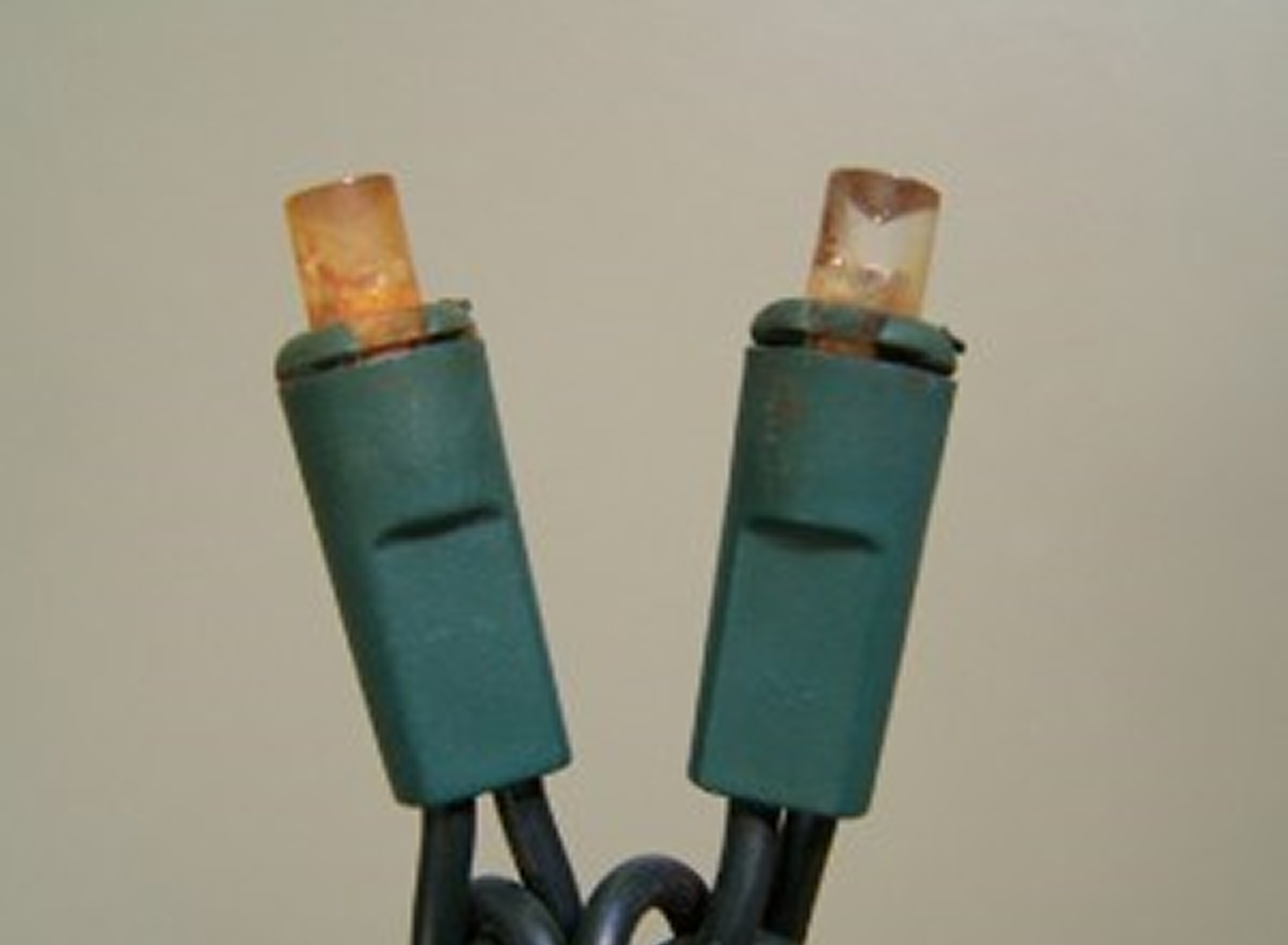
THE NON-REPLACEABLE SINGLE-MOLD CONSTRUCTION LED IS COMPLETELY WATERTIGHT—NO MOISTURE CAN ENTER THE AREA OF THE CONNECTION, AND THEREFORE, NO RUST CAN OCCUR.